


SINGAPORE (ICIS)–Japanese utility Tokyo Electric Power Co (TEPCO) has resumed commercial operations at the Kashiwazaki-Kariwa (KK) nuclear power station Unit 6, a groundbreaking and telling moment in efforts to reduce LNG demand in Japan’s power sector as the country grapples with potential new demand pressures and looks to find new generation sources.
TEPCO said on April 16 that it restarted commercial operations at the 1.35GW boiling water reactor after receiving pre-use confirmation and inspection pass certificates from Japan’s Nuclear Regulation Authority (NRA).
Commercial generation resumed at 4:00 p.m. local time, marking the first operational nuclear unit at the KK site since 2012 after all nuclear power plants in the country were successively shut in the wake of the TEPCO-operated Fukushima Daiichi nuclear plant accident from a massive tsunami in March 2011.
Market participants said the restart of KK Unit 6 — the largest single nuclear facility in Japan if all seven units were able to come online, which so far seems unlikely with only Unit 7 possible in the coming year or two — would directly displace gas-fired generation in TEPCO’s supply area, particularly during shoulder and summer periods when nuclear output can run at high capacity factors.
At full utilisation, KK Unit 6 could reduce LNG burn overall assuming replacement of combined-cycle gas turbine output, traders and analysts estimated, though actual displacement will depend on outage schedules, grid demand, and thermal dispatch economics.
Several traders said the restart could trim Japan’s spot LNG intake by one to two cargos per month on an annualised basis, assuming stable nuclear output.
“The KK Unit 6 restart eases pressure on power baseload requirements for LNG in eastern Japan,” a Japanese trader said. “This means less pressure on spot LNG needs, though one unit alone may not show quickly in reduced spot procurement or resale activity.”
But it is the lessons learned from regulatory hurdles, the mechanical complexity of restarting a reactor and allied generation after nearly 14 years offline that tells the wider story on restarting another eighteen nuclear units now offline and possible to get back in service at the upper end, let alone brand-new nuclear plants.
“Moving to restart any nuclear plant in Japan means public hearings, regulatory scrutiny and sensitive regional political considerations,” an energy analyst in Singapore said.
“We saw that with KK; the governor had to decide and went through all kinds of consultations. But maybe the series of energy emergencies from the 2011 tsunami, the Ukraine war and now with the Middle East – policy and public perceptions could become more accommodative.”
With KK, Japan now has 15 nuclear plants online, and depending on maintenance and operation snafus, is capable of operating nuclear capacity to roughly 33 GW, according to recent data from the US Energy Information Administration (EIA).
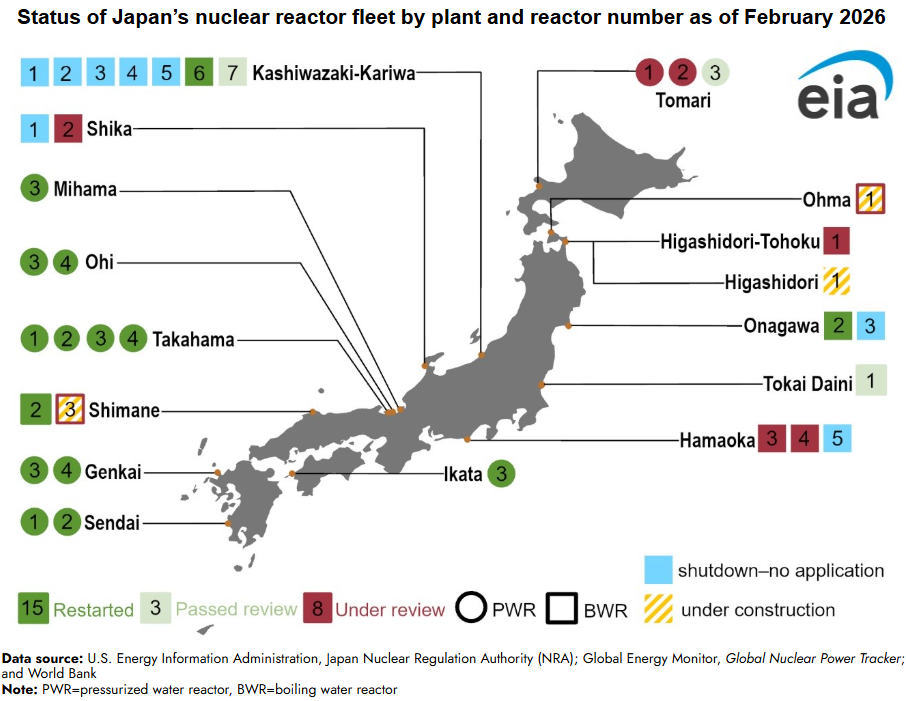
Another 24 nuclear power plants are permanently shut.
NEXT STEPS
Japan’s gas demand is the subject of policy debates and ties in with its extensive manufacturing sector in power trains, shipping and energy infrastructure – with renewables and non-fossil sources of fuel often talked about in connection to other decarbonization initiatives such as carbon capture and storage (CCS).
During the Iran war, energy importers across Asia, including Japan, turned to energy security plans that highlighted clear signs of LNG buyers already cutting consumption, end-users seeking a pivot to coal and nuclear where possible and spot market activity keeping a geopolitical risk premium in place.
The nuclear restart also improves TEPCO’s generation cost stack, as nuclear output is significantly cheaper than LNG-fired generation under current fuel and carbon pricing assumptions. Analysts expect increased nuclear availability to weigh on gas-fired dispatch hours and spark spreads in eastern Japan.
For LNG sellers, the return of large baseload nuclear units raises concerns about long-term demand elasticity in Japan, especially as contract renewals dominate procurement discussions toward the end of the decade, an LNG origination executive told ICIS.
“It shows that even if several roadblocks come up – Japan could pick up the pace of nuclear power output with a strong government push and offset some demand.”
Over the next two years, Japan’s nuclear restart efforts could realistically see three core units come online: Tomari‑3 (0.91 GW, Hokkaido Electric Power), Tokai Daini (1.16 GW, Japan Atomic Power Company), and Onagawa‑3 (0.83 GW, Tohoku Electric Power).
Any additional restarts beyond these are more likely to fall into the 2027–28 period and should be viewed as potential upside rather than hard expectations.
The Tohoku electric Higashidori Unit 1 (1.1 GW) remains under NRA review with extensive tsunami and seismic upgrades still in progress, though it is mentioned as a “next wave” restart.
Similarly, Shimane Unit 3 (1.37 GW Chugoku Electric) is technically complete, but the operator has prioritised restarting Shimane‑2 first and sequencing issues at the NRA mean Unit 3 is unlikely to be a base‑case restart before 2027.
Chubu Electric, meanwhile, has effectively shelved near‑term restart ambitions at Hamaoka, where Units 3–5 (3.6 GW) remain offline amid tough post‑Fukushima seismic scrutiny and regulatory setbacks over fault‑line and tsunami risk, leaving the utility broadly on the sidelines of Japan’s current nuclear restart cycle.
Post time: Apr-21-2026